Speak with any Non-Executive Director (NED), Advisory Board Member, or Chair; they will tell you about the incredible benefits and rewards they gain from their roles, despite all board appointments in Australia carrying risk. Having spoken to thousands of NEDs about why they pursue a board career, I think their reasons can be summarised into eight big ones.
#1 Professional Development
Sitting on a board gives you an insight into board-level decision-making and the dynamics of strategic relationships. Even though every board is different, as a non-executive, you can quickly learn where the levers are and how they influence your board’s decision-making.
Professional development is about seeking to advance and grow professionally by focusing on learning continuously, acquiring new skills, and gaining relevant experience to enhance one’s career prospects. Board and committee roles provide opportunities to engage in these activities.
#2 Career Development
One reason board appointments support career development is that, as a board and past executive recruiter, I typically ask aspiring executives and managers to provide evidence of their strategic experience. The keyword here is evidence. A significant number of individuals encounter difficulty with this particular task. However, individuals serving on boards often have a prepared response emphasising their strategic abilities and ability to collaborate with senior leaders. People without board experience struggle to showcase their strategic skills and may be at a disadvantage compared with those with prior experience.
#3 Relationship Building
There are two great ways to develop valued professional and personal relationships: participating in team sports or sitting on boards or committees together. Of course, there are others, but in both these cases, you are a group of disparate individuals coming together to achieve a common outcome. I firmly believe there are few better ways to get to know people than sitting around a board table, discussing issues everyone is passionate about. The relationships formed often turn into new business, career or personal opportunities. While serving in unpaid NED roles, I have always earned some income through the relationships I built at the board level.
#4 Giving Back
One of the things I hear most from people when I ask them why they want to join a board is, “I want to give back”. Every time I hear it, it sounds a bit clichéd, but it is an accurate statement that many people on boards instinctively understand. Plenty of evidence and advocates also support the personal benefits of giving back.
#5 Remuneration
I have written about how much you can expect to be remunerated for sitting on a board. For some, it is a nice reward, but for others, supporting their portfolio career or seeing them through retirement, remuneration is essential. It should be noted that even unremunerated or voluntary board roles can have financial benefits. As I mentioned earlier, I have never been paid for my board work, but I have always received some financial reward through the relationships and experience I have gained as a non-executive director.
#6 Professional Transitions
Many seek board experience as a fallback or preparation for executive transitions or post-executive life. Having been through the Global Financial Crisis as a recruiter, I can put my hand on my heart and tell you that it was because of my board experience that I was never unemployed during that period. Unlike most, my salary and professional experience increased during that time.
For senior executives, non-executive director roles assist with transitioning to retirement or semi-retirement. This allows them to step away from the stress of a full-time executive role, still earn an income, add value to an organisation, and share their knowledge and expertise.
#7 Business Development
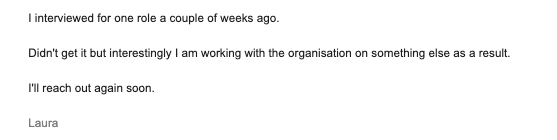
Pursuing a non-executive directorship often leads to executive or consulting opportunities, demonstrating that the search process itself can be highly lucrative. A member named Laura sent me the note above after she was shortlisted for a board seat that she was ultimately unsuccessful in gaining; however, the organisation was so impressed that they offered her a consulting contract instead. This outcome is common – pursuing a board appointment often serves as a catalyst for securing executive or consulting work alongside traditional board appointments.
#8 Your Brand & Profile
It is estimated that just 5% of adults hold a board appointment. So, while no one should accept a board appointment based on status alone, elevating your profile is a handy by-product. The title of being a ‘NED’ can open doors otherwise locked. It can give you access to those you would not usually have the opportunity to speak with – increasing your brand and access to otherwise inaccessible opportunities.
Don’t just take my word for it
According to a Harvard Business Review study, serving on a board increases the likelihood of executive promotion by 44% and leads to a 13% increase in pay, even if promotion does not occur.
There are compelling reasons to consider a board appointment. Board appointments are indicative of strategic success and imply the ability to work at a high level and possess a broader perspective than one may gain in an executive position. Research has found that individuals who hold board directorships in addition to an executive role experience increased employability, higher earnings, decreased unemployment rates, and enhanced personal and professional networks. Additionally, individuals are able to enhance their career prospects, secure more stable retirements, and handle unforeseen career transitions more effectively.
So, in my mind, the question is not ‘Is a board appointment worth the risk?’ but rather, ‘Where do I find board opportunities?’ and ‘How do I get appointed?’ The answer is… it is far easier than you think, and it is what we offer our Executive Members: a simple, easy-to-implement process that gets them appointed.
Relevant Articles
What is a Non-Executive Director in Australia, and what are the risks?