
I have spent over 20 years advising people on how to develop board careers. In that time, I have noticed that what separates the successful from the unsuccessful is having a plan. So, if you are serious about a board role in 2026, you need a Board Appointment Plan. Not just any old plan, but one that is proven to work and workable.
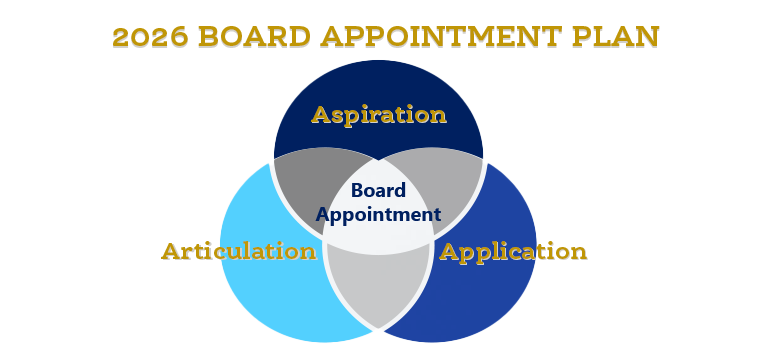
For these reasons, our board appointment plan has at its centre just three simple and highly effective ‘pillars’. Three pillars that have helped thousands of people find and be appointed to board roles. Why? Because, in my experience, complicated and onerous plans don’t work. Instead, your plan should focus on small, manageable sets of simple and easy-to-implement tasks. By making the tasks repeatable, this method ensures you can achieve your desired results without feeling overwhelmed.
Your 2026 Board Appointment Plan should focus on these tasks
Task 1: Tell people
One of the easiest ways to secure a board appointment is to tell people you are looking for one. They can’t help if they do not know.
Ensure you can seamlessly integrate your board aspirations into everyday conversations. For example, when asked what you do … “ I’m a Marketing Director at Company Y and building a board career… I am currently looking for a board appointment”. Another way to let people know is to ask them for feedback on your Board CV. Not only will you get some helpful information, but it is also an easy way to let people know you are serious about developing a board career and what your value is at board level. Oh, and writing one is going to help you better articulate your value at board level – Task 3/Pillar 2.
Task 2: Get narrow to get broad (Pillar 1)
Ask yourself this simple question. “What are the names of organisations I want to be, AND I am likely to be appointed to the board, based on my current skills and experience?”
Answering this question is the fundamental starting point for developing a list of target organisations. A list of 12 organisations makes Task 4/Pillar 3 more manageable by allowing you to focus on one organisation per month for 12 months. This approach provides clarity – meaning you:
- will stay focused;
- will not spend time chasing unrealistic goals;
- will not get sidetracked by attractive but unlikely opportunities;
- have conversations with like-minded people about your board aspirations;
- unlock a stream of individuals that you can develop weak tie relationships with, which can unlock opportunities that you simply won’t be able to access any other way.
Not having a list of targets that are aligned with your current skills and experience will result in you:
- being frustrated with a poor return for your efforts;
- relegating yourself to being reactive to the process – only responding to advertised or recruiter-led opportunities;
- chasing only highly competitive opportunities;
- applying for opportunities that you may be qualified for and passionate about, but can not get in front of the right person;
- applying for so many roles that you are stuck in application churn mode,
- submitting poor applications where you don’t stack up;
- having promising conversations with recruiters that, despite submitting well-written board applications, a board appointment never eventuates.
By focusing on 12 organisations and connecting with those connected to those organisations, you will not only gather the information and connections you need to make you a more compelling candidate, but you will also access board opportunities through these new connections. Opportunities that you would never have had access to otherwise. Being narrow helps you access broader opportunities.
Task 3: Have your board pitch & board CV (Pillar 2)
Do you know your value at board level? Yes, terrific. But what really counts is whether you can articulate it. Don’t start 2026 without a clear board pitch. A statement that answers a question you will regularly be asked: “Why do you want to be a Non-Executive/Why do you want a board role?”
You may be asked this question in several situations. It could be:
- at a formal networking event;
- at a social event;
- at the cricket with friends;
- at one of your children’s school events;
- at the bar on a cruise;
- on a chairlift on your annual ski holiday.
Of course, the question could and will be framed differently based on the scenario, but one version will be the first question you get asked during a board interview … “Why should we appoint you?”
In answering these questions, you need to consider what they are really asking. Essentially, they are trying to determine whether you are worth the risk. They want to know if they decide to help or appoint you, what is the potential for their reputation to take a hit? To provide confidence, you must understand and answer the fundamentals to the question … “Why should I risk my reputation on you?”
To build their confidence, you need to understand that they are not asking about your motivations. So waxing lyrical about the benefits to you of a board appointment won’t help. Instead, focus on the decision-makers’ motivators. There are 5 of them – governance experience, skills, connections, fit, and passion. All count equally, and none of them relate to your motivation.
To address this question, you need a compelling brief, a succinct verbal board pitch, and a clear board CV. A comprehensive board application should include at least three examples of success, which should also be incorporated into your interview responses. Now is the time to write your board profile, which is the foundation of your non-executive CV. If you already have one, it’s time to revise or refresh it. Then own it so you can pitch it confidently to anyone, anytime, in any situation.
Task 4: Do the work that works (Pillar 3)
If you don’t know already, over 80%+ of board roles are filled without a formal application process – using neither an advert nor a recruiter. “Oh, no networking!” I hear you yell. Not at all. “Well, what then?”
This task focuses on building personal connections. In particular, NEDs (past and present) who sit on the boards of the companies you want to be appointed to. Why them? These are individuals with whom you have something in common (your target organisation or cause) and, as such, can be approached legitimately and authentically. It also means that when you do approach them, they are more likely to accept your invitation to connect or have a conversation. These people become your ‘weak ties’, and weak ties account for 50% of all board appointments.
Why are they so powerful? There are several reasons, but one of the strongest is that they have access to, or an understanding of, opportunities that are related to the industry and sectors of your targets. They may also have contacts further afield who, if you get your pitch right, may facilitate access. Opportunities that you would never have found, or more likely discounted for, through formal channels.
Be realistic in 2026
Some think our approach is too simple. They assume a more complex board appointment plan is needed, as it is widely believed that the harder you work, the luckier or more successful you will be. However, they inevitably repeat ineffective strategies, become frustrated by the lack of progress, and eventually give up.
Your 2026 Board Appointment Plan should be simple and deliver four outcomes:
- Uncover board opportunities… opportunities others are unlikely to find, thereby significantly reducing the competitiveness of the board appointment process.
- Find board opportunities that are better suited to you and your skillset… making you a more compelling candidate;
- Get appointed faster and more often… because you will be more focused and encounter fewer obstacles; and
- Get a far greater return on your time investment … by redirecting your efforts away from recruiters or formal applications – approaches that only suck up your time, motivation, and rarely work.
Even with the world’s best board appointment plan, securing a board appointment takes time and perseverance. Having someone hold you accountable, like a physical trainer, to get the right work done, can be really helpful and supercharge your success.
My Executive Membership offers hands-on training that takes you through every step of the board appointment process. Additionally, I will personally draft your NED pitch and CV.
Related Articles
The 8 crucial elements of a compelling Board CV
About the Author

David Schwarz is CEO & Founder of Board Direction – Australia’s leading board advertising and non-executive career support firm. He has over a decade of experience of putting people on boards as an international headhunter and a non-executive recruiter and has interviewed over one thousand non-executives and placed hundreds into some of the most significant public, private and NFP roles in the world.
Share this article on your favourite platform!