

The 2026 Board Diversity Index, presenting survey results for ASX300 companies, has recently been released. Now in its twelfth year, the report – published by Watermark Search International in partnership with the Australian Institute of Company Directors (AICD) and, for the second year, Deloitte – once again puts five types of board diversity under the microscope: gender, cultural background, skills and experience, age, and tenure and independence. This year, it also continues to track the representation of First Nations, LGBTQ+, and people with disabilities. This article provides an overview of those findings and others, and offers insights into the implications for individuals seeking a board appointment.
The representation of genders on Australian boards
According to the 2026 Board Diversity Index, female representation on ASX300 boards reached 38% – up another percentage point on last year and nearly double the 20% recorded when the Index began tracking in 2016. The number of all-male boards has collapsed to just four across the entire ASX300 (1.4%), down from 11 only a year ago. All-male boards, which once dominated corporate Australia, are now close to extinction – the report openly asks whether 2027 will be the year every ASX300 board has at least one woman. One fifth of boards (21%) now have equal gender representation, and 72% have more than 30% women. On the typical ASX300 board – around seven directors, drawn from 2,057 board seats across 296 companies – you will now find roughly three women and four men.
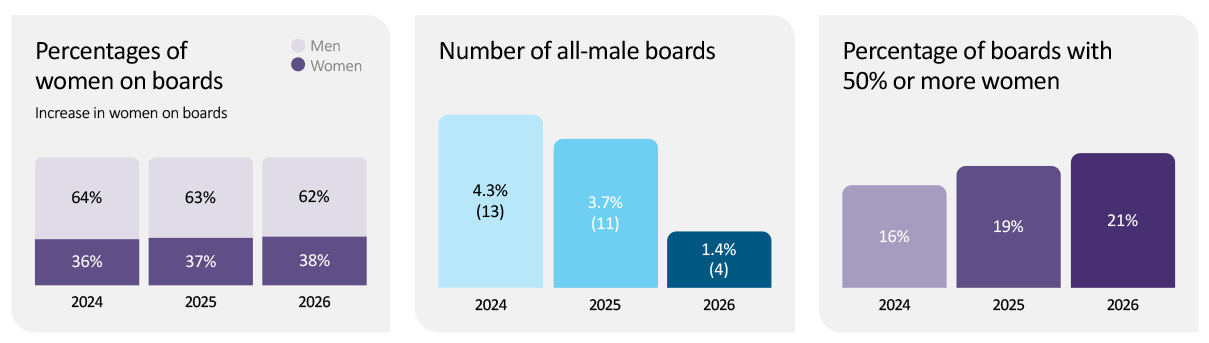
The progress, however, is uneven, and it largely stops at the boardroom door. The clearest reminder that the job is not done sits at the head of the table: there is still an 83% chance that an ASX300 chair is male. There were 11 more female chairs this year than last – real movement – but board leadership remains overwhelmingly male even as director-level numbers approach balance. The same unevenness shows up across the index. The AICD’s Gender Diversity Snapshot (as at 30 June 2025) showed women holding 39.3% of ASX100 directorships and 38.1% on the ASX200, but representation was actually easing at the very top of the market – down to around 41% on the ASX50 and 42% on the ASX20. In other words, the larger end of town that led the early gains now risks plateauing, while the rest of the index continues to climb.
Federal Government boards lead the way on gender diversity
Gender diversity data is available for Australian Federal Government boards because of the government’s long-standing commitment to gender balance and transparency. 2026 marks 15 years since the first Gender Balance on Australian Government Boards Report, and over that period, women’s representation has climbed by more than 20 percentage points – from 33.4% in 2009 to 54.3% in 2025.
Separately, the latest Gender Balance on Australian Government Boards Report 2024–25 shows the government meeting its headline target (Target 1: women holding at least 50% of all board positions) for the fourth consecutive year, at 54.3% overall. For the first time, this figure includes all appointed positions, such as ex officio roles; counting government-appointed positions only, women held 55.7%, an increase of 1.3%. Progress is also being made against the more demanding targets introduced more recently:
- Individual board level (Target 2 – 40% women per board): 83.8% of boards now meet this, or 299 of the 357 boards across government portfolios – up from 78.4% the year before.
- Portfolio level (Target 3 – 50% women per portfolio): 70.6% of portfolios meet it, or 12 of 17.
- Leadership at the portfolio level (Target 4 – 50% of chair and deputy chair roles): 52.9% of portfolios meet this target, or 9 of 17.
Reforms such as the new Australian Government Appointments Framework and the Workplace Gender Equality Agency’s public-sector reporting are designed to sustain this momentum by broadening the candidate pool and encouraging the public advertising of roles. The contrast with the corporate sector is striking: at 54.3%, government boards have already passed the parity mark on gender, while ASX300 boards sit at 38%. For aspiring directors, that gap is worth paying attention to – and I’ll return to it in the takeaways below.
The gender gains are masking deeper diversity gaps
It would be easy to read the gender numbers and conclude that Australian boardrooms are becoming genuinely diverse. The 2026 data tells a more sobering story. On almost every other measure the report tracks, progress has stalled or gone backwards.
- Cultural Background: just 6.5% of ASX300 directors are from non-Anglo-Celtic backgrounds – down from 8.1% in 2025, 9% in 2024 and 9.5% back in 2017. The trend is not flat; it is reversing.
- First Nations: Indigenous directors now hold just five board seats – down from seven – shared among only four individuals across the entire ASX300.
- LGBTQ+: only five directors openly identify as LGBTQ+, up by one from last year.
- Disability: not a single ASX300 director has disclosed living with a disability.
These figures are extraordinary, and they matter. At a time of rapid AI adoption, geopolitical uncertainty and genuine concern about social cohesion, these are the decision-making engine rooms shaping outcomes for millions of staff, customers and stakeholders. The absence of these perspectives raises real questions about the breadth of experience around the table.
The cultural diversity of Australian directors remains unsatisfactory
Cultural diversity deserves to be singled out because it is the one area where boards are actively moving in the wrong direction. With 93.5% of directors from Anglo-Celtic backgrounds, ASX300 boards look nothing like the multicultural Australia they serve, and the non-Anglo-Celtic share has fallen in successive years – from 9.5% in 2017 to 6.5% in 2026. Even among the small group of overseas-born directors, the mix is narrow: around a quarter of directors are from outside Australia (down from 29%), and that cohort is dominated by North America (47.5%), the UK (16.4%) and New Zealand (15.6%) rather than Asia. Census after census shows a population with deep and growing Asian, Indian and other non-European heritage, yet that reality is barely reflected in the boardroom, which impacts board effectiveness.
The age diversity of directors in Australia
2026 has again seen little movement in the headline age profile of ASX300 directors: the average age is essentially unchanged at 60.9 years. Beneath that stable number, though, the genders are quietly converging. The average age of male directors is drifting down (from 62.3 in 2024 to 61.8 in 2026), while the average age of female directors is rising (from 58.7 to 59.6 over the same period). The share of directors under 50 has slipped slightly, and the share over 70 has edged up. It will be intriguing to watch these dynamics shift further as today’s longer-serving directors retire and a younger cohort – more fluent in technology and more comfortable with fast-moving change – is ushered in to replace them.
Director skills, experience & qualifications
Whilst skills and experience may not be the first thing that comes to mind when you think about diversity, when it comes to governing the top companies in Australia (and many other organisations), a genuine diversity of skills is essential.
The data continues to show boards leaning heavily on Accounting and Financial Services expertise, which remains comfortably the most-represented skill set on ASX300 boards at 37.8% – though that share has slowly declined, from 39.6% in 2016 to 38.7% last year. The gap is being filled by exactly the capability boards now need most: Technology and IT experience has climbed to 10% of directors, up from 7.7% a year ago, as boards grapple with digital disruption and AI. We also note this trend across all organisations and industries in our comprehensive board vacancy listings.
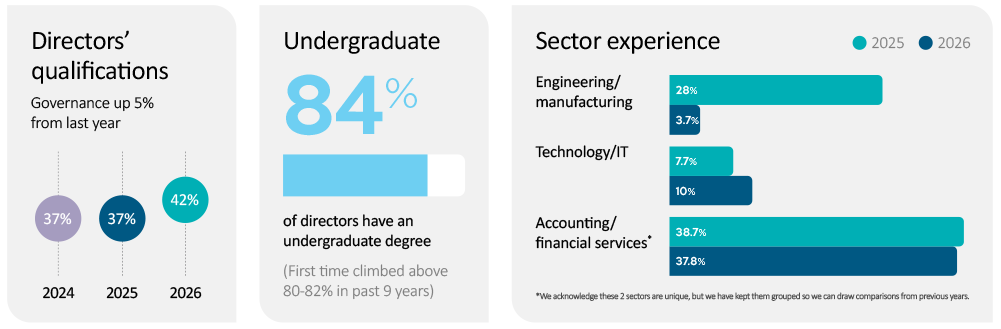
On formal qualifications, the picture supports advice I have given for years: a governance qualification will sharpen your directorial skills, but it does not guarantee a board appointment. Only 42% of ASX300 directors hold a governance qualification – up five percentage points on last year – and, interestingly, 61% of female directors hold one, double the 31% rate among men. Advanced degrees carry less weight than many candidates assume: just 29% of directors hold an MBA or PhD (up three points). An undergraduate degree, by contrast, is close to standard, and for the first time in nine years, the figure has climbed above its long-running 80–82% band to 84% of directors.
Other notable board diversity statistics
Director independence
The vast majority of ASX300 directors – 80% – are considered independent. It is worth noting, though, that boards became slightly less independent this year: 20% of directors are now classed as non-independent, up from 18% last year.
Board tenure
Tenure at the ASX300 level continues to shorten gradually. The majority of directors (56.1%, up from 54.5%) have held their seats for fewer than five years, and 85.7% for less than a decade. The same is true at the top: 70.2% of chairs have been in the role for under ten years. This steady refresh of board seats is precisely what creates opportunity – as longer-serving directors reach the end of their tenure, the seats they vacate become the openings that aspiring non-executive directors compete for. It is also worth knowing that 83% of directors hold only one ASX300 seat; just 17% of seats are held by directors who sit on multiple ASX300 boards.
Geographic diversity
Another way the Australian Government fosters board diversity is by ensuring that boards, advisory boards and committees draw members from the relevant states and across metropolitan, regional and rural areas. Government reporting has consistently shown all states and the Northern Territory fairly represented relative to their share of the population. The standout exception is the ACT, which holds a far higher share of appointments than its population would suggest – understandable, given that some roles require public servants based in Canberra.
Why board diversity matters more than ever in 2026
The case for diversity has shifted from a question of fairness to a question of capability. Boards in 2026 are being asked to govern through the fastest technology shift in a generation, heightened geopolitical risk, and rising community expectations around social cohesion and trust. A board drawn from a narrow band of backgrounds, cultures and experiences is simply less equipped to anticipate how those forces will land on its staff, customers and communities. In essence, the boards that get the mix right will be better positioned to navigate disruption and lead into the future.
“White, male with an MBA” is becoming less common – but slowly
The findings suggest board appointment trends are shifting – albeit slowly – at the top of the market. As the “old guard” of NEDs gradually retires, they are being replaced by directors who bring different skills, experiences and demographics suited to a fast-evolving business environment.
Key takeaways for those seeking board appointments
Securing a board appointment has always been a competitive process, regardless of gender, age or professional background. Even with strong qualifications, you must know and articulate your value more than other candidates.
- Board diversity does matter at the ASX300 level – but the tenure system means it will still take time to see genuine diversity across most measures, especially culture, First Nations and disability representation, where progress has stalled or reversed.
- You don’t need a governance qualification, an MBA, or a finance or law degree to be a Non-Executive Director. They can help you perform the role, but they do not guarantee an appointment.
- Seriously consider a role on a government board, advisory board or committee. These roles are paid, frequently include diversity as an explicit selection criterion, and – at 54.3% women – demonstrate that balanced boards are entirely achievable.
- If you are located in a regional or rural area, a government role is especially worth pursuing, given the deliberate focus on geographic representation.
- Be realistic about your aspirations and build a clear board appointment plan. If your goal is a NED role on an ASX300-listed company, be prepared for fierce competition: there are around 2,057 board seats across the entire
- ASX300, and the great majority are independent director positions.
ASX-listed boards are still age-heavy, but those seats will turn over as tenures end. The directors who fill them will be chosen not for their age, gender or background, but because they bring the skills, perspectives and fluency in current and emerging technology that the company needs to thrive. - If cultural background, First Nations heritage, disability or LGBTQ+ representation is part of the perspective you bring, the data shows boards have a long way to go – and a real need for exactly that contribution.
- Start developing a plan for your board career early – speak to us.
This article draws on the latest publicly available data and reports; therefore, it analyses the current board diversity landscape across the ASX300 and federal government organisations. These diversity statistics and trends should not be applied to the broader Non-Executive Director (NED) community and boards, including state or local government, not-for-profit, smaller public companies or private organisations. These are likely to have different needs, statistics and trends.
Resources
The 2026 Board Diversity Index
Gender Balance on Australian Government Boards Report 2024–25
Related Articles
Is a governance qualification required for a board appointment?
About the Author

David Schwarz is CEO & Founder of Board Direction – Australia’s leading board advertising and non-executive career support firm. He has over a decade of experience of putting people on boards as an international headhunter and a non-executive recruiter and has interviewed over one thousand non-executives and placed hundreds into some of the most significant public, private and NFP roles in the world.
Share this article on your favourite platform!
